
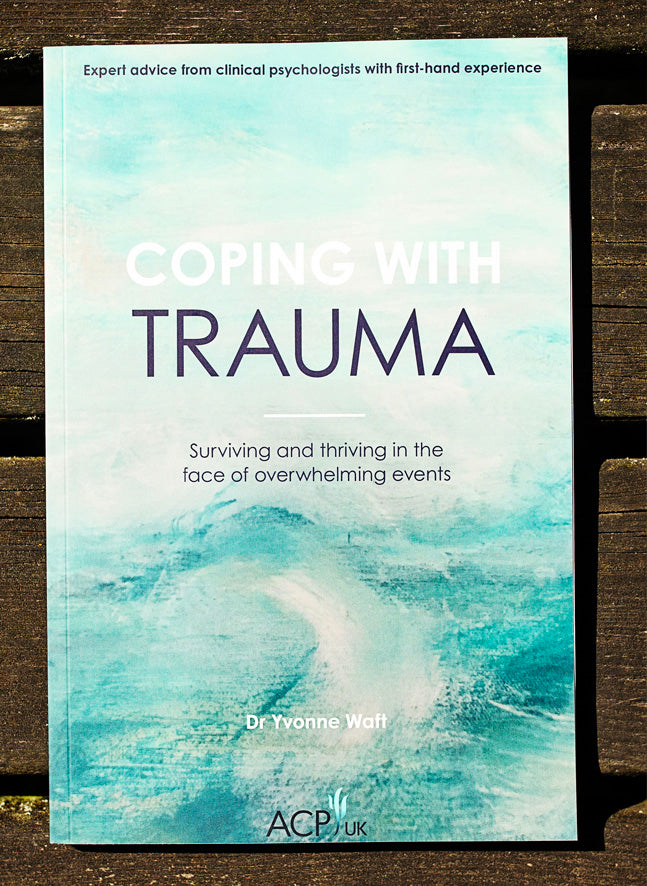
Coping with trauma - Dr Yvonne L Waft
Coping with trauma - Dr Yvonne L Waft
Trauma is everywhere, from relatively simple car accidents all the way through to childhood neglect and abuse, or devastating combat experiences. These events have specific emotional and behavioural effects on a person.
Accessing good quality professional support with the aftereffects of trauma can be a lottery and people are often left wondering what on earth is happening to their mind. Statutory services can be underfunded and have long waiting lists. Private services can be very costly, outside of many people’s budgets. So where can you get good quality, evidence-based advice to help yourself?
This self-help book is the first of its kind: written by a highly experienced Clinical Psychologist, who has experienced significant trauma in her own life. Drawing on a range of therapeutic approaches including Acceptance and Commitment Therapy (ACT), Cognitive Behavioural Therapy (CBT), Compassion Focused Therapy (CFT) among others, this book helps you to understand what is happening to you in the aftermath of trauma and how to cope with these impacts. The approaches used in this book enable you to respond differently to the painful thoughts and feelings you have, and to recognise when your natural responses may be preventing you from moving forward towards the life you want to live. You will gain an understanding of how trauma works, enabling you to respond to yourself more compassionately, and you will learn tried and tested skills to cope well, moving from mere surviving, to thriving.
Share

-
DR YVONNE WAFT is a well renowned Clinical Psychologist, EMDR Consultant and Facilitator with many years’ experience working with trauma and complex trauma, both in the NHS and in private practice. In December 2023, she published her first book, Coping with Trauma, based not only on her vast clinical experience in the field, but also on her personal experiences of trauma. The book came about as part of a collaboration between Sequoia Books and the Association of Clinical Psychologists. The aim of the collaboration is to create a series of books by clinical psychologists with personal experience of the topics they write about. Series editor, Dr Sarah Swan, initiated the idea for the series after her experience with breast cancer during the pandemic in 2020. She found writing about her experience helpful and saw the potential for this series.
-
As a chartered clinical psychologist who has specialised in trauma, and an EMDR Consultant and Supervisor myself, I read Yvonne’s book soon after publication. My first impression was that it is a very easy-to read guide to a complex subject. The clarity of the language used makes it ideally suited to the lay-person, without the need for a scientific or psychological background. As such, this book fulfils a much-needed gap in the market of self-help for trauma. Often, the first step in trauma-focused therapy is to explain what trauma is and what the various symptoms mean. This is addressed in Yvonne’s book, with even very complex presentations being discussed in a matter of fact, de-stigmatising way. I particularly liked the way the different types of trauma were presented, including simple and complex trauma, attachment trauma, intergenerational trauma, and global trauma. I appreciated the way Yvonne distinguished between the need for diagnostic accuracy in certain fields, such as medico-legal work, versus the need for a looser, more traumainformed approach in the clinic room.
-
One real strength of this book is that it gives self-help exercises that can safely be done at home. This can either be in place of, or in preparation for, formal therapy. The exercises will all be familiar to anyone working in the field of trauma therapy and are part of the usual repertoire of the ‘stabilisation techniques’ we all use. I would argue that this makes the book an ideal primer for anyone starting out on a professional career in clinical or counselling psychology, or psychotherapy. What early-stage practitioner psychologist didn’t yearn for some techniques to use in the room with a new client? I certainly did.
-
In the past, I have had a number of go-to books to recommend to clients at the start of trauma therapy. Russ Harris’ The Happiness Trap is good for learning stabilisation skills but does not address trauma specifically, whereas Bessel van der Kolk’s The Body Keeps the Score is good for understanding trauma but can be too academic and complex for many of the people we are helping in clinic. I have always wished for a Happiness Trap for Trauma, or a simplified version of The Body Keeps the Score, as a handbook to go alongside trauma therapy. Yvonne’s book really does fit that gap very neatly. I now recommend Coping with Trauma to people enquiring about trauma therapy and have heard good feedback from people who have read it in advance of starting therapy with me.
-
Yvonne’s book draws on a wide range of theory and research, whilst not coming over as an academic text at all. Yvonne has managed to condense a huge amount of current thinking on trauma and how to manage the symptoms, at a self-help level. This will benefit people struggling to access formal trauma therapy or just wanting to prepare themselves ahead of therapy starting. It will also be hugely beneficial to people at the start of a career in the helping professions, needing to understand what might be going on for their client, and to give some ideas of how to get started with helping them.
For anyone thinking of teaching the psychology of trauma at any level – this should be considered recommended reading.
This is a pre-publication version of the following article: Kingston D (2025). Book Review: Coping with Trauma: Surviving and thriving in the face of overwhelming events.Psychology Teaching Review Vol. 31, No. 2, pp127-128
Author
Dr Deborah Kingston BSc (Hons) PgCert DClinPsy CPsychol, Clinical Director of Psychological Therapeutic Solutions Ltd.
Bluesky: drdebskingston.bsky.social
Website: https://www.ptsolutionsltd.com/